Picture this, you are walking down a path or road.
What do the surroundings look like? Mountains, hiking trails, city scape.
How are you moving along this path or road? Are you walking, running, skipping?
What are you thinking about? Are your thoughts calm, busy, ruminating?
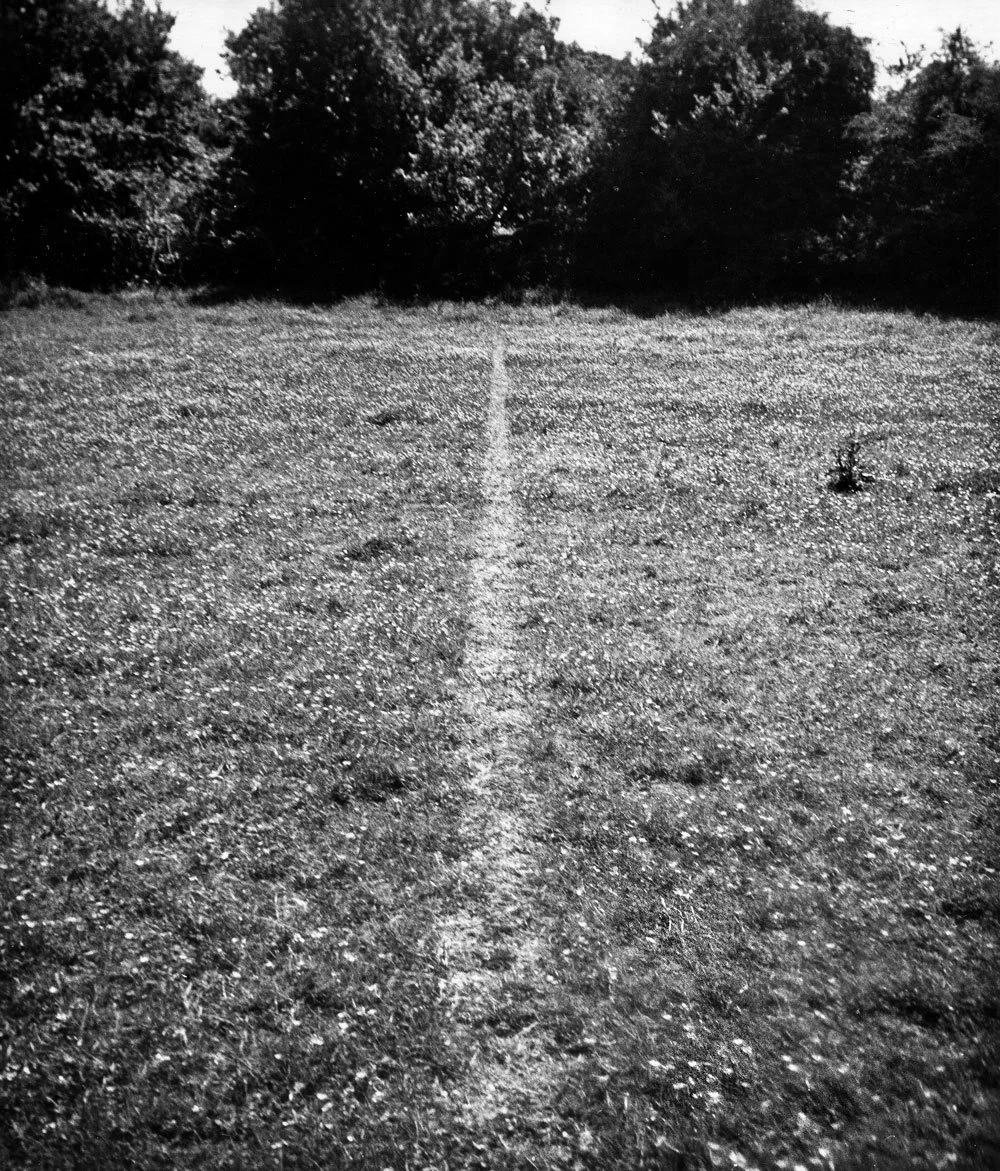
Richard Long, A Line Made by Walking (1967)
The path or road is a line of direction, we are always traveling and it’s something that is used daily. It’s how we get from one point to another. Whether it is physically moving on a path or road or metaphorically laying out a road map for how you want your life to go or the spiritual path. The path is something that is a constant whether we realize it or not. In the Book of Symbols, it says, “In essence, “path” implies direction. In the face of chaos and a sense that the events of life are random, it offers something linear, a suggestion of meaning.” (454) The path has so many nuances and meanings, it represents the unknown, a frontier yet to be discovered, pilgrimage, adventure, wisdom or it can reference the course of a person's life.
In the stories of folklore and myth, we see the themes of the path or road through the lens of the Hero’s Journey, and Crossroads. In the Hero’s Journey, the main character must go down a path that is riddled with obstacles, choices and challenges that they have to overcome, think Star Wars, Harry Potter, and Lord of the Rings. The Crossroads is a place where paths converge, a junction, a liminal space. There are many possibilities but only one choice and in that place is where someone confronts his/her/their choice. Think the Greek goddess Hecte (goddess of magic and the crossroads), and American Blues artist Robert Johnson.
In spirituality, we see paths and roads as symbols for life’s journey. How to live more in accordance with a person's true nature. In the Buddhist tradition, there is the Eightfold Path which is the path to liberation from samsara (cycles of birth, death, and rebirth). In Taoism, there is the Tao Te Ching, an Ancient Chinese text that is about the path to virtue. In Christianity, path is referenced as a way to live in more accordance with Jesus’s teachings.
A physical space to explore spirituality is a labyrinth, a path that has no dead ends and something that you will find in almost every part of the world. A labyrinth is a place of prayer, meditation or contemplation. Famously, the Chartres Cathedral in France has a giant labyrinth where you can walk and meditate. If you can’t make it to France to walk this labyrinth, you can do labyrinth tracing. An exercise where you trace a labyrinth with your finger, pen, or pencil. Start at the beginning of the labyrinth and trace along the path until you reach the center, take a deep breath and when you are ready to move again start to trace the path back out.
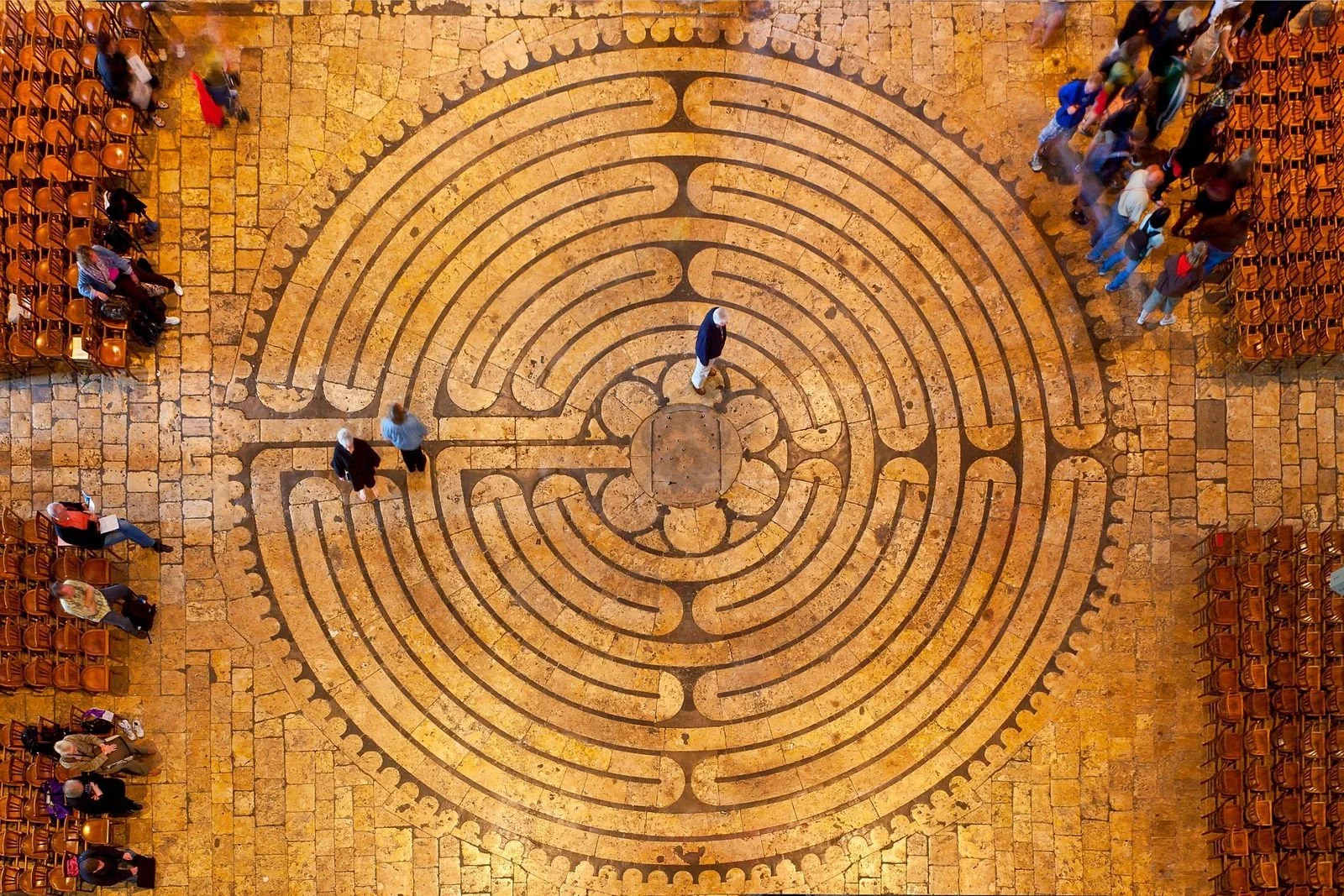
The Labyrinth at Chartres Cathedral, Photo by Sonnet Sylvain
Another type of meditation is walking meditation. This type of meditation is where you bring awareness to how you move, breath, and your surroundings. Just like a sitting meditation, you keep coming back to your breath and can be done indoors or outdoors. Focus on how you are walking and then link your breath with movement.
If sitting down to meditate is hard, this week I invite you to do either labyrinth tracing or walking mediation. Try it out a few times this week and observe how you feel afterwards, write down any thing that came through for you.